




Best Of
Re: Aspire A715-42G Windows11 BIOS update? Since it upgraded I have had a number of crashes.
An updated BIOS is likely necessary for your Aspire A715-42G to run Windows 11 reliably and fix system crashes. Incompatible or outdated drivers are a common cause of stability problems after a major OS upgrade.
Warning: Updating your BIOS is an advanced procedure. Read all instructions carefully and do not interrupt the update process, or you risk permanent damage to your computer.
Step 1: Check your current BIOS version
Click the Start button and search for System Information.
Open the app and find the row labeled "BIOS Version/Date".
Take note of the version number. You will use this to confirm the update was successful later.Step 2: Download the latest BIOS from Acer
Go to the official Acer Support website: https://www.acer.com/us-en/support/drivers-and-manuals.
Search for your model by entering Aspire A715-42G or your laptop's serial number or SNID.
Under the "BIOS/Firmware" tab, locate and download the latest version. For the A715-42G, this is likely version 1.10.
Step 3: Update the BIOS
Back up your important data before starting.
Connect your AC power adapter. The update will not proceed without it.
Right-click the downloaded ZIP file and select "Extract All".
Navigate to the extracted folder and double-click the executable file (e.g., BIOS.exe).
If you see a Windows Defender or User Account Control prompt, confirm that you want to proceed.
The tool will launch, and you will need to click OK to begin the update.
Do not turn off or restart your laptop during the process. Your system will reboot automatically.
-----------------------------------------
If this answers your question & solved your query please "Click on Like" and then Yes "Answered".
 Axxo
Axxo
Re: Does Aspire 15 A15-41M-R7ZM USB4 port support Thunderbolt?
OK, after some trial and error here are my results:
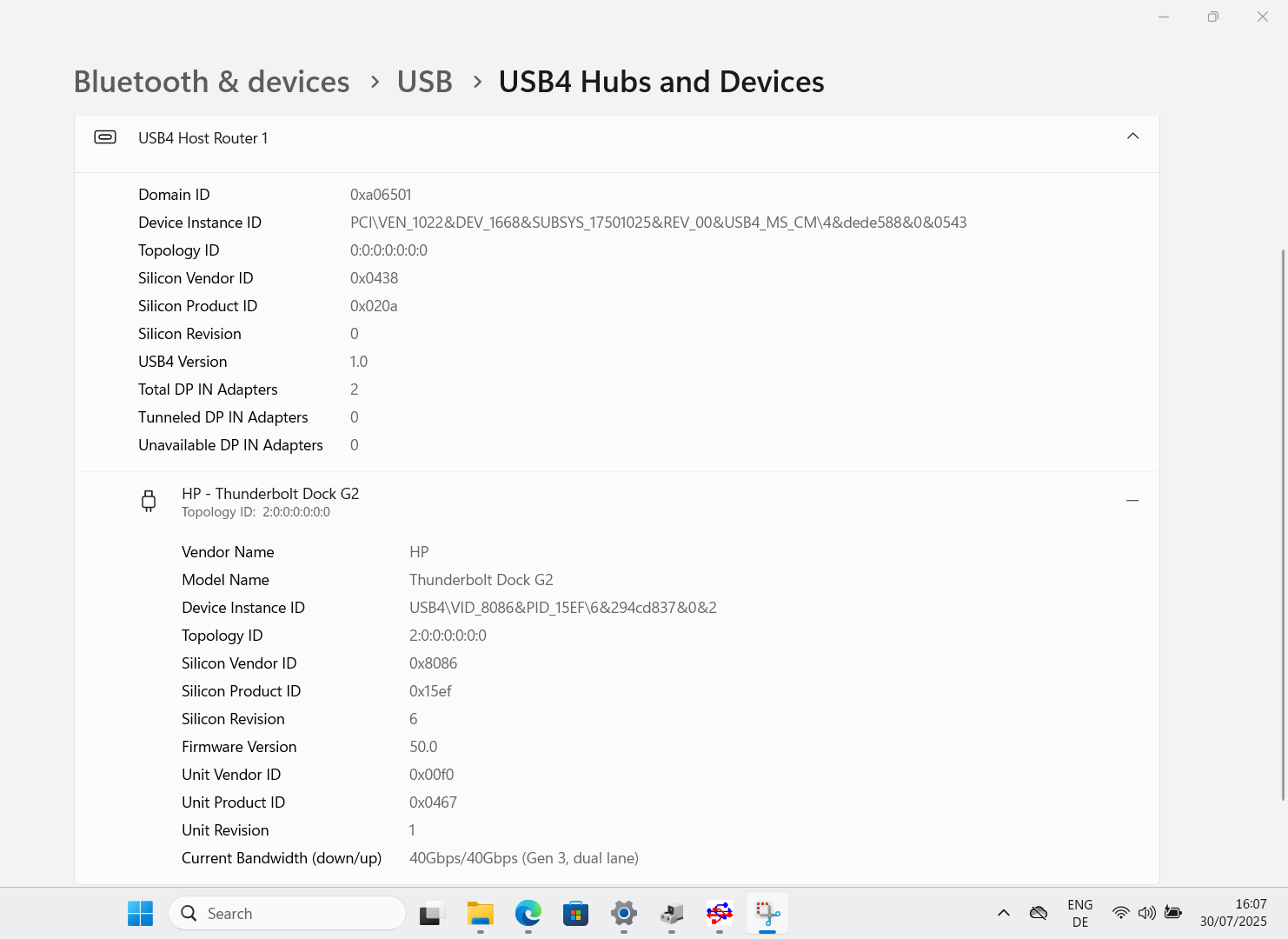
First in Windows there is limited reporting regarding Thunderbolt, I only found 1 place in settings where it shows the link speed is 40GBps,
see below screenshot:
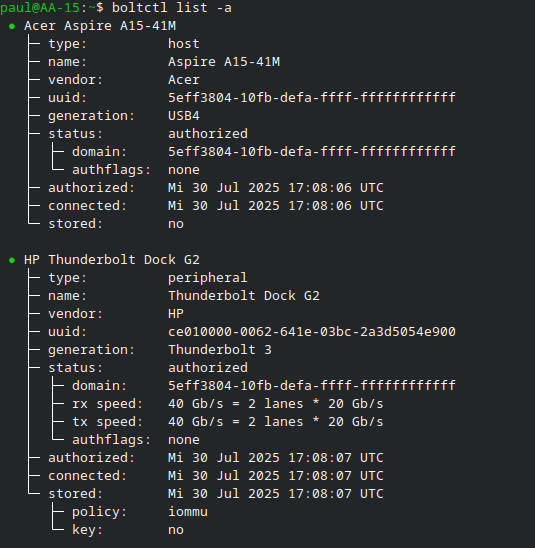
In Linux there are way more commands to analyze the capabilities of TB, so here are some screenshots and explanations:
In the following screenshot we see pretty much the same as in Windows that the dock is correctly identified and that we have 40GBps link speed:
In the next screenshot we see the in Thunderbolt controller name: Advanced Micro Devices, Inc. [AMD] Pink Sardine USB4/Thunderbolt NHI controller
Which is good to know that the internal identification shows that it is in fact a USB4/TB controller, so it should in fact support the capabilities of Thunderbolt 3 if not also 4.

Personally I just bought an old HP Thunderbolt G2 dock, for 50€, and it is supported and works without issues I would guess that other TB3 docks should also work without issue, but YMMV.
I did not yet have time and the resources to test a TB4 dock or an eGPU, but some others reported in other forums that this controller should be able to handle an eGPU albeit with some issues as mentioned in this forum thread:
I just hope that this will help other in the future and that manufacturers more clearly state what features there USB4 implemenation suuport.😑
 paulo88
Re: Can I use a 2TB PCle 4 nvme ssd on my laptop? #anv15-51 789J
Hi tfield12354
- This laptop includes two PCIe M.2 SSD slots, both supporting Gen 4 NVMe drives up to 4TB capacity.
- For optimal performance, reliability, and thermal efficiency, the Samsung 990 EVO Plus Gen4 NVMe SSD is a solid choice.
- It runs cool under load, delivers fast sequential speeds, and maintains consistent performance across workloads.
 Puraw
Puraw
Re: Can I use a 2TB PCle 4 nvme ssd on my laptop? #anv15-51 789J
Your Acer ANV15-51-789J laptop supports M.2 2280 PCIe NVMe SSDs. While the slot may be PCIe 3.0, it’s fully compatible with PCIe 4.0 SSDs, which will operate at reduced speeds. A 2TB SSD is supported and commonly used in this model
Click on "Yes" if it answers your question or Click on "Like" if you find my answer useful
 Diya1811
Re: Can I use a 2TB PCle 4 nvme ssd on my laptop? #anv15-51 789J
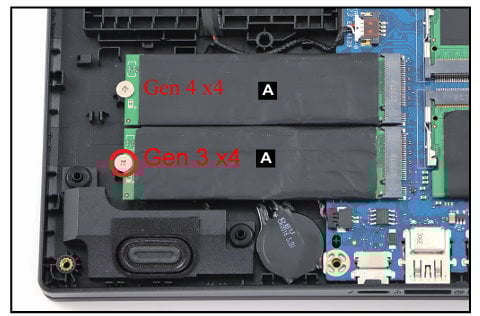
YES, your Nitro ANV15-51 can operate with a Gen 4 x4 M.2 1TB 2TB or 4TB M.2 SSD drive only in its boot drive slot, as NOT both M.2 slots are Gen 4 x4 type slots, so be aware of that and don't get confused.
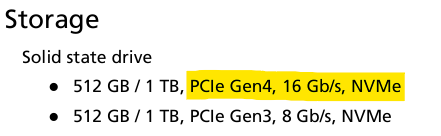
The ANV15-51 has a boot M.2 slot at a speed of a Gen 4 x4 lane type drive and the secondary M.2 slot is a Gen 3 x4 lane M.2 SSD drive type, see specs below.
Also, I suggest that you look at the best performing tested M.2 SSD drives as tested by Tom's Hardware SSD M.2 Benchmarks 2025 HERE, so look at these charts as its a great guide for all the speeds of the M.2 SSD drive suitable for your ANV15-51 laptop. Good luck and hope this helps you out further.
The quickest 2TB Gen 4 x4 M.2 SSD that they have tested is the WD Black SN7100 2TB at 6,997 Seq MB/s and 2,049 Copy MB/s, so consider this drive or the 2TB Samsung 990 EVO.
Nitro ANV15-51 storage specs as per Acer SG, highlighted is the boot drive specs:
M.2 SSD drive specs position slots in the laptop
If this answers your question and solved your query please "Click on Yes" or "Click on Like" if you find my answer useful👍

Re: Why is there a 1GB partition between Drive C and D and how can I transfer space from D to C around it?
On some models they partition the drive with a C: drive that holds the system files and a D: drive that is supposed to be just for data. Unfortunately when they set the partitions up like that, the recovery partition is created right after the system partition, and before the data partition. That's a Microsoft thing, where they create the EFI partition, then the system partition, then the recovery partition and only do a data partition last. The best way to deal with it, unless you want to have a separate data partition, is to move everything off the data partition, then delete the data partition, then use a partition utility to move the recovery partition to the end of the disk, then expand the system partition to fill the space between.
 billsey
Re: Why is there a 1GB partition between Drive C and D and how can I transfer space from D to C around it?
Hi CJR1
The 1 GB partition you see between C: and D: is a recovery or system volume created automatically by Windows or the OEM. It contains boot or recovery files and should not be deleted or modified.
What is less clear is what you mean by “Drive D.” If D: is a separate physical SSD, then the 1 GB partition is unrelated and simply sits at the end of the C: disk. If D: is instead another partition carved out of the same boot drive, then Windows Disk Management will show it directly after that 1 GB recovery volume.
To clarify:
- Open Disk Management (press Windows key + X, choose Disk Management).
- Look at the graphical layout at the bottom. Each physical disk is labeled “Disk 0,” “Disk 1,” etc.
- If C:, the 1 GB partition, and D: are all on “Disk 0,” then D: is just another partition on the same drive.
- If D: appears under “Disk 1” or another disk number, then it is a separate SSD.
In either case, leave the 1 GB recovery partition untouched. It is required for system recovery and updates.
For reference, Microsoft explains recovery partitions here: https://learn.microsoft.com/en-us/windows-hardware/manufacture/desktop/windows-recovery-environment--windows-re--technical-reference
Puraw